



Loaders move fast, yards are busy, and the margin for error is thin. For a company that supplies the concrete, aggregates and precast products behind Australia’s roads, bridges and buildings, keeping that environment safe is not a box to tick. It is the job.
That is why Holcim, one of Australia’s leading suppliers of aggregates, ready mix concrete and concrete pipe and products, has become one of the earliest and most committed adopters of Blindsight, the AI powered vision safety solution developed by Presien and distributed across Australia and New Zealand by Aptella.
Blindsight uses AI driven cameras and sensors to give operators genuine oversight of what is happening around their machine, distinguishing people from other obstacles in real time and alerting operators the moment someone enters a danger zone. For a business running quarries, batching plants and manufacturing sites across the country, the technology addresses one of the industry’s oldest and most persistent risks: the interaction between heavy vehicles and pedestrians.
“At Holcim, what we’re trying to do is understand the interactions between heavy vehicles and pedestrians in our plants,” says Darren Haber, Area Operations Manager at Holcim. “We’re investing significantly in new machinery, but also that machinery is coming fitted already with the Blindsight system. So having these new machines come to site ready to rock and roll makes things so much easier, but safer as well.”
Nick Corr, Market Development Manager of Safety at Aptella, has worked closely with Holcim since the earliest days of the rollout. “They were very early adopters of the vision AI technology Blindsight,” Corr says. “They work in tight yards. They needed to make sure that there’s a clear delineation between plant and people.”
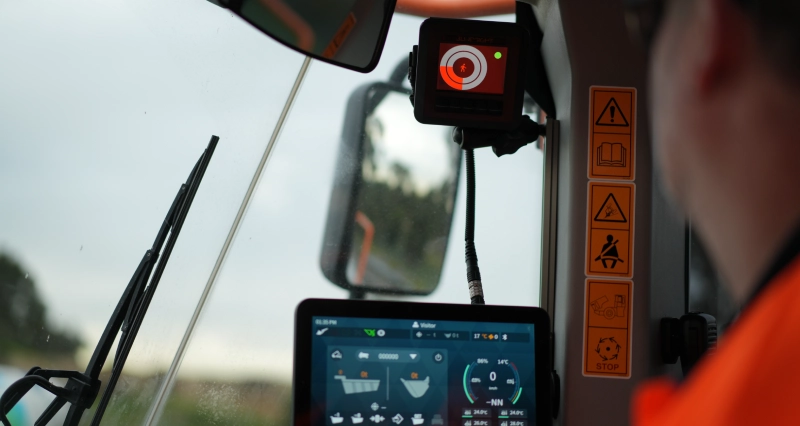
For operators like Haber, the value of Blindsight is felt most directly behind the controls. Working a front end loader through a busy plant at pace demands total awareness of the surrounding environment, awareness that is not always easy to maintain from inside the cab.
“When I’m operating a front end loader, when you’re operating in that area and you’re operating at a quick pace, we need to have that assurance that we’ve got oversight of where we’re working and our surroundings,” Haber says. “Having a system like this makes our job so much easier, and it keeps the people around us safe.”
What sets Blindsight apart, according to Corr, is not only the real time alerting but what happens with the data afterwards. “The game changer with Blindsight is that it has a comprehensive reporting platform that enables our customers and users to drill down and identify where the risks are within their business.”
At Holcim, that reporting has become part of daily operations. Haber uses the Blindsight dashboard to track detections across sites and understand where attention is needed most. “On the dashboard, it’ll give me an overview of the detections, so I can understand how many detections I’ve had and which plants. It really gives me the data that I need to understand where I need to put my focus.”
Every detection is backed by video, giving Holcim a level of transparency that extends well beyond the individual operator. Corr points to how the business has built that footage into its broader safety culture. “There’s a video of every detection that’s been generated. They use it for training, and they also use it for things like toolbox talks and pre starts, so that they reiterate that message about safety within their business.”
For Haber, the value of the technology comes back to a simple principle that underpins Holcim’s approach to safety. “All in all, it’s there to keep our people safe. So the more we know, the more we understand, the better it is for everyone.”
As Holcim continues to invest in new machinery fitted with Blindsight from the outset, that principle is becoming built into the way the business operates, one plant, one detection and one shift at a time.