



For McConnell Dowell, one of Australia’s largest engineering and construction contractors, that proof now comes from twelve months of hard data collected across a range of civil and rail projects, generated by Blindsight, the AI powered vision safety solution developed by Presien and distributed by Aptella.
“We’re always looking for new ways to protect our people,” says Ashleigh Oldham, Senior Safety Advisor at McConnell Dowell. “Blindsight’s an AI system that we fit on some of our pieces of plant. We’ve been using it for about 12 months now, on a range of different projects across civil and rail.”
McConnell Dowell’s projects span some of the most complex infrastructure in the country, from level crossing removals to rail corridor upgrades, all of it built in environments where plant and people inevitably come close together. Rather than fitting a standard system and hoping it worked, Aptella and McConnell Dowell began by mapping exactly where the danger sat.
“We’ve been working with McConnell Dowell for over 12 months,” says Nick Corr, Market Development Manager of Safety at Aptella. “They needed to recognise where the risk was within their business. We worked with McConnell Dowell on identifying the risk around that equipment and how to adapt Blindsight to work on their equipment, to keep their employees safe at all times.”
That collaboration has continued well past installation. “We’ve been working with the McConnell Dowell team to look at tweaking the technology so it better suits our equipment,” Corr adds, a reminder that Blindsight’s value depends on how closely it is configured to the reality of each site and each machine.
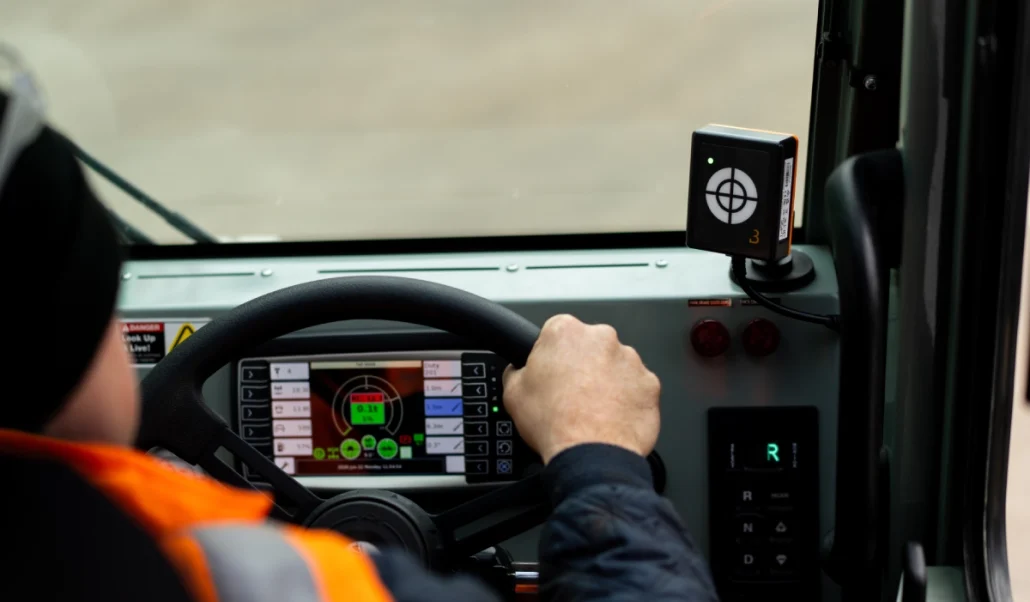
On the ground, the difference is immediate and practical. When someone enters a plant operating zone, the operator gets a real time alert, and the response is simple.
“The biggest benefit is for our workers working around the plant, within those plant operating zones, and for our operators,” Oldham says. “It gives them a real time alert when someone encroaches that danger zone, and then it allows them to just stop and wait for that person to exit through their zone.”
It is a small pause with significant consequences, replacing a moment of uncertainty with a clear, repeatable action.
For Oldham, one of the most valuable aspects of Blindsight has nothing to do with alerts in the moment and everything to do with what happens afterwards. Every detection is backed by real footage, giving McConnell Dowell an evidence base that goes beyond what gets written up after the fact.
“The alerts provide us with real time footage of what is occurring,” Oldham says. “It doesn’t rely on just what was reported by individuals. There’s actual camera footage and alerts that show what is happening out on site.”
That footage, gathered consistently over a year, has let Aptella and McConnell Dowell move from anecdote to evidence. “Looking at the data over the last 12 months, what we’ve seen is a significant reduction of those high and critical detection events around equipment,” Corr says. “And this is primarily due to behaviour, people understanding where they are, the operator being alerted so that they’re able to stop, head check, and make sure that there’s nobody around their equipment.”
In other words, the technology has not just been recording risk. It has been changing behaviour around it.
For a Senior Safety Advisor overseeing multiple sites, that shift matters. Blindsight has become one more layer of assurance in an industry where the goal never changes, no matter how many projects are underway.
“Our goal is always for everybody to go home without harm every night,” Oldham says. “Blindsight gives us another set of eyes for people working on the ground around the plant.”