



Beyond Paper Trails: The Technology That’s Reshaping Construction Site Management
As one of Australia’s most respected civil contractors, Daracon Group has long been trusted to deliver complex infrastructure projects with professionalism and precision. When the opportunity arose to pilot Aptella’s integrated haul tracking solution on a challenging site remediation and construction project in regional New South Wales, Daracon approached the collaboration with both curiosity and caution.
Nine months on, what began as a trial has become the project’s go-to tool for managing bulk earthworks with greater efficiency and confidence.
“We were initially skeptical, but our assumptions were challenged in the best way,” says Harrison Newman, Site Engineer at Daracon. “What we thought might just be a helpful add-on, has proved itself to be a valuable core primary tool.”
The transformation didn’t happen overnight. But for Australia’s civil construction industry—under increasing pressure from compliance, cost control, and project complexity—contractors’ experience with Aptella’s Haul Dashboard signals a fundamental shift away from decades-old practices toward data-driven precision.
Breaking the Clipboard Cycle
The scene is familiar across construction sites worldwide: clipboard-wielding Supervisors manually recording truck movements, operators scribbling load details on bouncing dashboards, and Project Managers spending hours cross-referencing handwritten sheets with spreadsheets. It’s a system that has persisted for decades, despite being labor intensive, error prone, and frustratingly slow to identify problems.
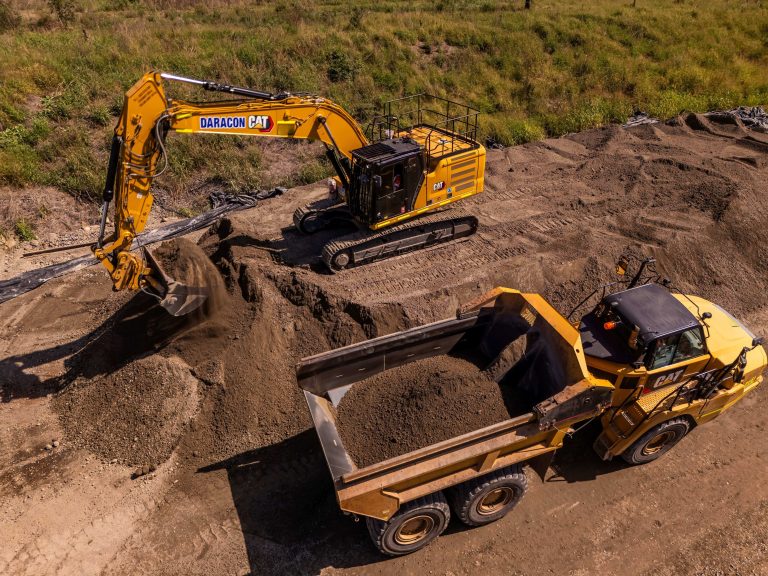
When Daracon took on the complex task of capping an existing landfill cell and constructing a new one, at a regulated site in regional New South Wales, this traditional approach fell short of the project’s unique demands. The project, situated on the grounds of a former quarry, demanded precise material traceability and accountability that paper systems couldn’t reliably deliver.
Aptella’s Haul Dashboard was designed to change that paradigm entirely.
“We built the dashboard to give real time, visual insights into material flow,” explains Mark Clarkson, National Market Development Manager at Aptella. “Customers were getting mountains of data out of the Haul Truck systems — but in spreadsheet form. It was difficult to act on. We wanted to turn that data into something intuitive and decision ready.”
The result is a comprehensive three-part ecosystem:
Putting Technology to the Test
While the Topcon Haul Truck App and Sitelink platform had already seen widespread use, Daracon was the first to trial the full integrated solution including Aptella’s custom Haul Dashboard — and the timing couldn’t have been better. The project required extreme accuracy in tracking the movement of bulk earthworks across multiple zones, all within a tightly controlled regulatory framework.
“My job is all about traceability,” says Newman. “Where the material comes from, where it goes, what kind it is, whether it can be reused — all of that needed to be documented. The Aptella dashboard allowed us to do that with confidence.”
Newman approached the trial with characteristic caution, running the dashboard alongside traditional manual load sheets to cross check accuracy. “We ran the dashboard alongside our manual load sheets to cross-check everything early on,” he admits. “But by the end, we were relying on the app and dashboard alone. It made my work easier, and more importantly, it made the data more trustworthy.”
The system proved itself quickly. Even subcontractor operators who’d never seen the app before were onboarded and using it effectively within hours. “We handed out phones to external operators on a Saturday,” Newman recounts. “By Monday morning, I had the full report ready to send to the client — no cross-referencing, no delays. That kind of time saving is significant.”
What struck Newman most wasn’t just the efficiency gains, but the quality of data. “I had someone in a truck with a pen trying to write on a bouncing clipboard,” he laughs. “Now I have a visual map with every load tracked.”
When Every Second Counts
One of the standout advantages of the Aptella Haul Dashboard is its ability to highlight discrepancies or delays before they escalate into project threatening problems.
“With traditional systems, data analysis can take weeks,” Clarkson says. “By then, the window to act has closed. Our dashboard compares your actuals to your targets live — so you can correct course the same day.”
For Daracon, that meant Newman could spend less time manually verifying loads in person and more time managing the overall quality of the project. “I didn’t need to stand there watching every truck,” he explains. “If I wasn’t on site, I could just log in, open the dashboard, and see exactly where things were moving.”
This real time visibility proved transformative. Issues like missed dumps, misplaced loads, or incorrect data entries could be identified and addressed immediately.
The impact extended beyond operational efficiency. “You enter your targets, and the dashboard tells you if you’re on pace,” Clarkson explains. “It does the calculations for you. It’s no longer weeks of spreadsheet work – it’s four-hour updates and live decisions.”
Meeting Documentation Demands with Confidence
The nature of the project made documentation particularly critical. “Everything goes over weighbridges,” Newman explains. “You have to account for every kilo. There needs to be clear evidence that all materials are suitable, traceable, and placed exactly where they are intended.”
With the Haul Dashboard, Daracon could produce visual reports showing exactly what was moved, from where, and to which part of the site — including cubic metre counts, timestamps, and load trails. That level of detail helped smooth approvals and strengthened trust with project stakeholders.
When scope-changes arose, clean, colour-coded reports could be generated in minutes rather than hours of sifting through handwritten sheets. “Being able to pinpoint exact dump and load locations, matched with volumes, gave us solid backing to prove we were using appropriate material,” Newman notes.
The system’s reporting capabilities proved particularly valuable when dealing with oversight and compliance. Where traditional methods might leave gaps or inconsistencies that could trigger costly delays, the dashboard provided bulletproof documentation.
And while Daracon didn’t enable the system’s full material type classification features on this job, Newman reflected on the benefits the feature may add in the future. “We didn’t need scale-based weight tracking or detailed material types this time around,” but for future phases, I’d definitely advocate for full implementation. The traceability is phenomenal — and that is central to my role as a Site Engineer.”
Smooth Learning Curve, Maximum Results A key challenge for any new technology is up take in the field. In the Construction industry, workers tend to be familiar with the tried and tested methods of record management, and in some instances, there can be a misconception that digital solutions tend to complicate, rather than simplify their work.
The Aptella Haul Dashboard and Topcon Haul Truck system defied these expectations entirely.
The mobile app, designed for simplicity, helped shift focus away from outdated load sheets toward better data ownership on the ground. Users appreciated being able to leave notes, correct their own entries, and avoid paperwork entirely.
“I could log in from anywhere and see exactly where trucks had loaded and dumped — down to specific plots — and have complete data by Monday morning,” Newman says. “What used to take hours of manual cross-referencing was available instantly.”
The intuitively designed technology ensured the learning curve on site was minimal. Even experienced Operators who’d spent years with paper systems adapted very quickly.
One of the system’s most powerful advantages is its ability to retain data even if Operators lose signal or accidentally log out. Movement data is cached locally and syncs seamlessly once reconnected, ensuring nothing is lost, and no time is wasted. “That gave us real confidence,” Newman explains. “We never had to worry about gaps if someone forgot to log back in, because the system caught up automatically.” This continuity is essential on dynamic sites where disruptions are common.
Service That Actually Serves
Daracon credits much of the success of the implementation to Aptella’s support team — particularly Clarkson’s availability and responsiveness.
“In this industry, when there’s a problem, you needed an answer yesterday,” Newman emphasises. “Mark was fantastic. Whether it was early morning calls or access issues, he was always willing to help. Every issue we had was resolved within 24 hours.”
This level of responsive service isn’t just customer relations, it’s a competitive differentiator in an industry where project delays can cost thousands of dollars per day. When an app access issue briefly slowed progress, Aptella’s team worked quickly behind the scenes to restore functionality without data loss, a critical feature of the dashboard’s resilience.
The personalised approach sets Aptella apart from larger competitors. While many global suppliers offer generic solutions built for mass markets, Aptella’s dashboard is customisable to suit each individual project and its requirements. “No two dashboards are the same,” Clarkson says. “We build them around your KPIs, your contracts, and your targets. It’s tailored tracking that multinationals can’t provide.” Clarkson continues, “Most global suppliers offer one-size-fits-all solutions, we customise everything, from the interface to the reporting metrics. It’s technology that adapts to how you work, not the other way around.”
Beyond the Trial Phase
After over nine months of daily use across thousands of loads, the Daracon team now sees the Haul Dashboard as a primary system on this project, not a secondary one.
“It started as a trial, but we’ll be recommending it company-wide for all major earthworks projects,” Newman says. “It’s proven its worth.”
The implications extend beyond individual projects. As the construction industry faces mounting pressure for compliance, cost control, and operational efficiency, solutions like Aptella’s dashboard represent more than technological advancement, they signal a fundamental shift in how work gets done.
“Most global suppliers write one version of software for thousands of users,” Clarkson observes. “We created something that adapts to each project’s unique requirements. It’s not just data collection, it’s live, actionable intelligence.”
The future promises even greater integration. “Automation is where things are heading,” Newman predicts. “We didn’t use every feature this time, like auto loading zones, as we wanted to take a measured approach. But with each use, and as we continue to observe the systems capabilities firsthand, our confidence builds. The industry’s almost there.”
As autonomous vehicles and AI-driven systems become increasingly prevalent, the ability to track, verify, and respond to material movement in real time becomes even more critical. For contractors seeking to reduce rework, improve accountability, satisfy stakeholders, and maintain profitability, integrated solutions combining hardware and intelligent software aren’t just helpful additions, they’re becoming essential tools for competitive survival.
Daracon’s experience demonstrates that the future of construction management isn’t about choosing between traditional methods and new technology, it’s about embracing systems that make better decisions possible, faster.
“We appreciate the learnings from our collaboration with Aptella,” Newman concludes. “It was definitely worth our time.”
As the industry continues evolving, that sentiment may well become the standard rather than the exception. The clipboard era isn’t quite over, but its days are numbered.